
You are planning a dinner party, a wedding reception, or a New Year's celebration, and you need to know how many bottles of champagne to buy. The question seems simple enough: how many glasses are in a bottle? But the answer depends on several factors, including the size of your pour, the shape of your glass, and whether you are toasting once or drinking throughout the evening. Here is the straightforward math, along with practical guidance for planning events of any size.
How Many Glasses in a Bottle of Champagne?
The quick math from this guide, by pour size and bottle format.
| Format | Volume | Glasses |
|---|---|---|
| Standard bottle, standard 125ml pour | 750ml | 6 |
| Standard bottle, generous 150ml pour | 750ml | 5 |
| Standard bottle, toast-only 100ml pour | 750ml | 7-8 |
| Magnum | 1.5L | About 12 |
| Jeroboam | 3L | About 24 |
| Methuselah | 6L | About 48 |
| Nebuchadnezzar | 15L | About 120 |
The Standard Bottle Math
A standard bottle of champagne holds 750 milliliters of wine. The standard champagne pour is approximately 125 milliliters, which is slightly less than the typical still wine pour of 150 milliliters. The smaller pour accounts for the effervescence -- bubbles take up space in the glass, and overfilling a champagne glass leads to foam spilling over the rim.
At 125 milliliters per glass, a standard 750ml bottle yields six glasses. This is the number most event planners, caterers, and sommeliers use as their baseline. It is a reliable figure for a proper pour in a standard champagne flute or tulip glass.
However, if you are pouring generously -- closer to 150 milliliters per glass -- you will get five glasses per bottle. And if you are pouring smaller tasting portions or toast-only servings of about 100 milliliters, you can stretch a bottle to seven or even eight glasses.
Adjusting for Glass Shape
The shape and size of your glass affects how much you pour, even if you do not realize it. A standard champagne flute holds between 170 and 240 milliliters when filled to the brim, but you should never fill a flute to the top. A proper pour fills the glass about two-thirds full, leaving room for aromas and preventing spills.
A coupe glass, with its wide shallow bowl, can hold 180 to 240 milliliters but looks awkwardly empty when filled to just a third of its capacity. People tend to pour more into coupes, which means you may get closer to four or five glasses per bottle rather than six.
Tulip glasses fall somewhere in between. Their shape naturally guides you toward a moderate pour, and their slightly wider bowl means the champagne has room to breathe without requiring an overly large pour to look right.
If you are buying glasses for an event and want consistent pours, choose glasses with a similar capacity and shape for every table. Our crystal champagne glasses come in matched sets that make this easy.
Party Planning by the Numbers
Here is a practical guide for estimating how many bottles you need based on your event size and format:
For a toast-only event, where each guest gets one glass for a single toast, plan on one bottle for every six guests. For 50 guests, that is about nine bottles, and you should round up to ten to account for spillage and the champagne that stays in the bottle after the last glass is poured.
For a cocktail reception lasting two to three hours where champagne is the primary drink, estimate two to three glasses per person. For 50 guests, that means 100 to 150 glasses, which translates to 17 to 25 bottles. Round up and plan for 20 to 28 bottles.
For a dinner party where champagne is served alongside other wines, one or two glasses per guest is typical. A table of eight will go through roughly two bottles during the champagne course.
For a wedding reception with a champagne toast plus additional champagne service, plan on two glasses per guest for the toast and reception period, plus one additional glass per guest if champagne will be available during dinner. A 150-guest wedding might need 35 to 50 bottles.
Always buy more than your calculation suggests. Bottles do not pour perfectly -- there is always a small amount left at the bottom, and some champagne is lost to foam during pouring. A buffer of 10 to 15 percent ensures you do not run short.
Larger Bottle Formats
Champagne is available in several bottle sizes larger than the standard 750ml, and these can be both practical and impressive for events.
A Magnum holds 1.5 liters, equivalent to two standard bottles, yielding about 12 glasses. Many champagne experts consider the Magnum the ideal format because the wine-to-air ratio during aging produces champagne that is often more complex and ages more gracefully.
A Jeroboam holds 3 liters (four standard bottles, about 24 glasses). A Methuselah holds 6 liters (eight bottles, roughly 48 glasses). And the legendary Nebuchadnezzar holds 15 liters -- equivalent to 20 standard bottles and roughly 120 glasses.
Large-format bottles make a dramatic impression at events. Pouring from a Magnum or Jeroboam adds ceremony to the service, and these bottles often become conversation pieces. Just make sure you have someone strong enough to handle the pour -- a full Jeroboam weighs nearly five kilograms.
Making Every Glass Count
Regardless of how many bottles you buy, the experience comes down to the individual glass in each guest's hand. A beautiful crystal glass makes a $15 bottle of sparkling wine feel celebratory, while a plastic cup makes even expensive champagne feel disposable.
Investing in proper glassware is one of the highest-impact, lowest-cost upgrades you can make to any champagne occasion. A set of crystal flutes or tulips costs less than a single bottle of prestige champagne, but it enhances every bottle you pour through it for years to come.
Browse our full collection of crystal champagne glasses to find the glassware that makes every pour, every toast, and every celebration worthy of the moment.
Shop Our Crystal Champagne Flutes
Celebrate in style with Luxrify's crystal champagne flutes:
- Iridescent Crystal Champagne Flutes -- Rainbow shimmer champagne flutes
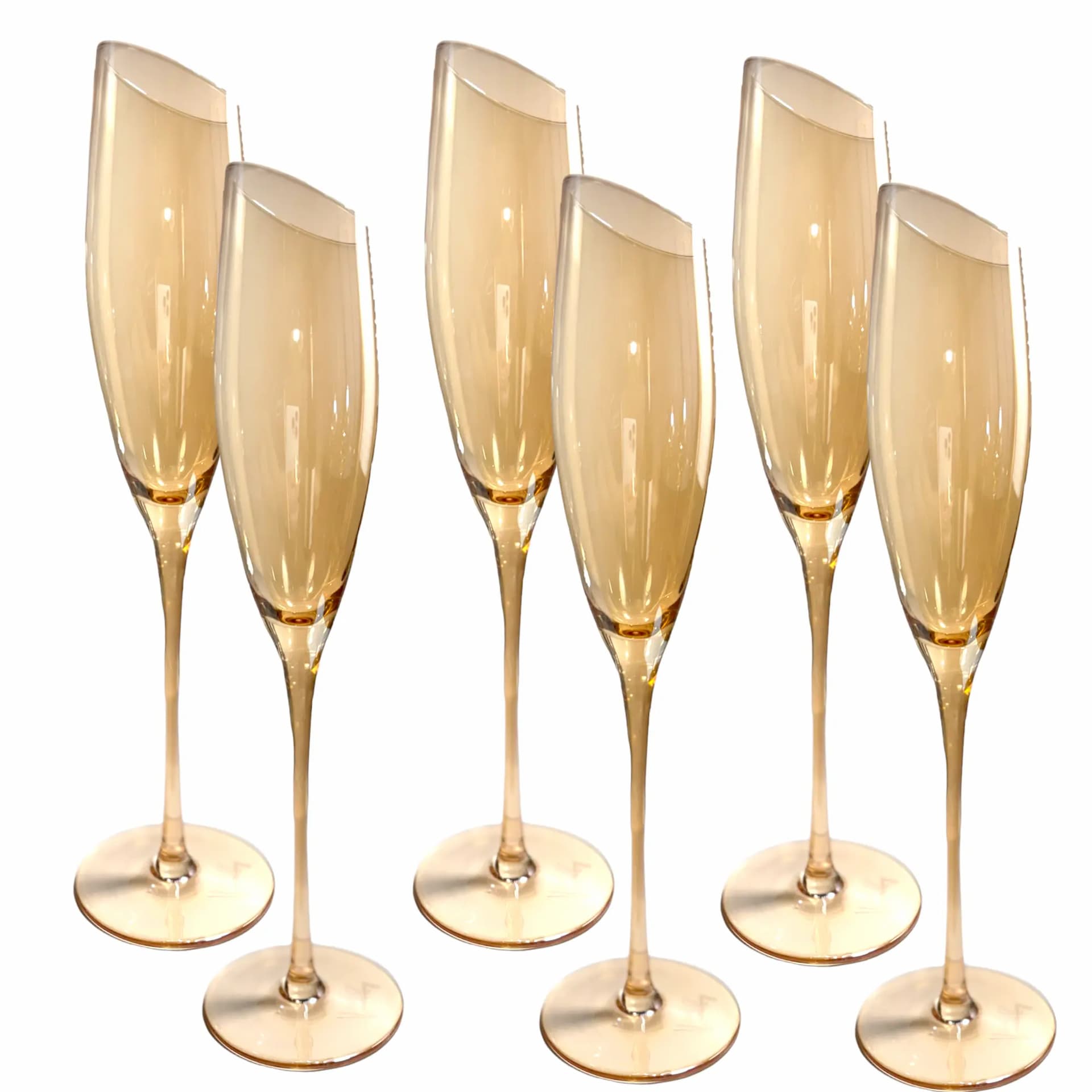
- Amber Crystal Champagne Flutes -- Warm amber crystal flutes
- View All Champagne Flutes
Free shipping on all orders. 30-day satisfaction guarantee.

