
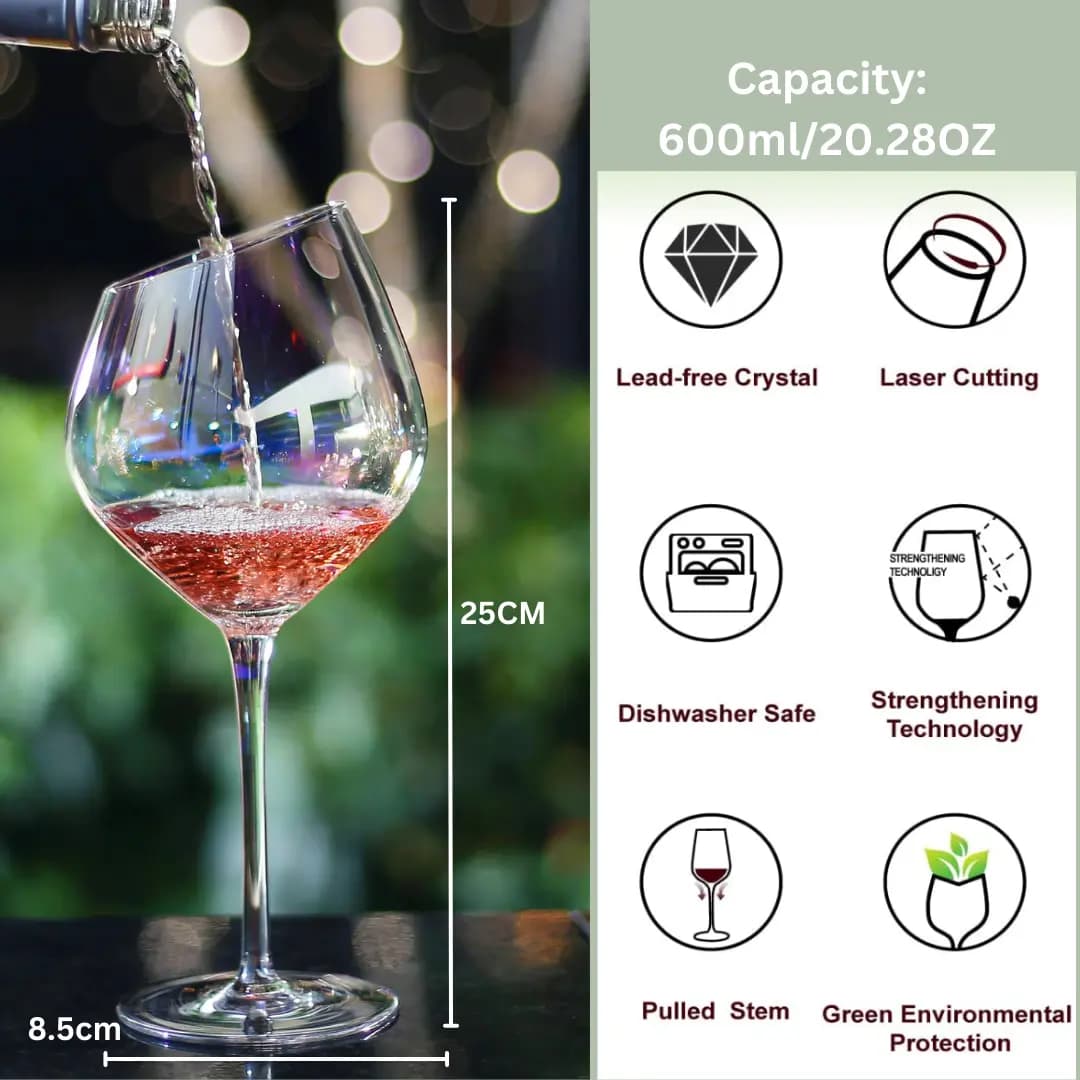
If you have ever shopped for wine glasses with any seriousness, you have encountered two names that come up again and again: Burgundy and Bordeaux. These are not just marketing labels. They represent two fundamentally different design philosophies, each engineered to optimize a specific category of red wine. Understanding the difference between them -- and knowing when to reach for which -- is one of the most practical pieces of wine knowledge you can acquire.
Burgundy vs Bordeaux Glass: The Key Differences at a Glance
Here is how the two classic red wine glass shapes compare on every dimension that matters.
| Feature | Burgundy Glass | Bordeaux Glass |
|---|---|---|
| Bowl shape | Wide, rounded, balloon-like | Taller, narrower, tulip-shaped |
| Bowl width | Widest of any standard wine glass | Moderate |
| Height | Shorter, broader profile | Tallest of the red wine glasses |
| Typical capacity | 22-30 oz | 18-24 oz |
| Rim/opening | Strongly tapered, narrow relative to the bowl | Moderately tapered, more open |
| Best for grapes | Pinot Noir, Nebbiolo, Gamay | Cabernet Sauvignon, Merlot, Malbec, Syrah |
| How it delivers wine to palate | Spreads wine across the full tongue, highlighting fruit and acidity | Channels wine toward the center and back of the palate, softening tannins |
The Burgundy Glass: Wide, Round, and Aromatic
The Burgundy glass takes its name from the Burgundy region of eastern France, home to the world's most revered Pinot Noir. Burgundian wines are typically lighter in body, lower in tannin, and extraordinarily complex in their aromatics. They whisper rather than shout, and the glass needs to amplify those whispers.
To achieve this, the Burgundy glass features the widest bowl of any standard wine glass. Picture a generous, nearly spherical shape -- like a goldfish bowl on a stem. This broad circumference creates a large surface area where the wine can interact with air, releasing the delicate aromatic compounds that make Pinot Noir, Nebbiolo, and similar grapes so captivating.
The bowl then curves inward toward the top, creating a narrower opening. This tapering is pronounced -- the rim diameter is significantly smaller than the bowl's widest point. The effect is a kind of aromatic funnel that captures volatile scent molecules and channels them directly toward your nose. When you bring a properly filled Burgundy glass to your face, you should be enveloped by the wine's perfume before you take a sip.
Typical Burgundy glasses hold between 22 and 30 ounces, though you should only pour about 6 ounces at a time. The empty space above the wine is not wasted -- it is the aroma chamber, and it is essential to how the glass works.
The Bordeaux Glass: Tall, Structured, and Directional
The Bordeaux glass is named for the wine region of southwestern France, where Cabernet Sauvignon, Merlot, and Cabernet Franc produce powerful, tannic blends built for aging. These wines are full-bodied, high in alcohol relative to Burgundy, and structured around firm tannins that need management rather than amplification.
The Bordeaux glass addresses these characteristics with a taller, more upright silhouette. The bowl is narrower than a Burgundy glass but taller, creating a shape that is sometimes described as tulip-like or chimney-like. This design serves several purposes.
First, the height creates distance between the wine's surface and your nose. With wines that run 14 to 15 percent alcohol, this vertical space allows sharp alcohol vapors to dissipate before reaching your nostrils, so you smell fruit and earth rather than ethanol.
Second, the moderate bowl width provides sufficient aeration without overdoing it. Cabernet and Merlot have bolder, more robust aromatics than Pinot Noir. They do not need as much surface area to express themselves. Too wide a bowl can actually cause their aromas to scatter and become diffuse.
Third, the Bordeaux glass's opening, while narrower than its belly, is less dramatically tapered than a Burgundy glass. This allows a controlled amount of airflow that keeps the wine evolving without trapping aromas to the same extent.
Bordeaux glasses typically hold 18 to 24 ounces, making them slightly smaller than their Burgundy counterparts.
Side by Side: Key Differences
Placing the two glasses next to each other makes the differences immediately obvious. The Burgundy glass is rounder and wider, sitting lower and broader on the table. The Bordeaux glass stands taller and more upright, with a more elegant, vertical profile.
Pick them up and the weight difference is apparent too. A larger Burgundy bowl means more glass (or crystal), and when filled, it has a different center of gravity that requires a slightly different hand position. The Bordeaux glass feels more balanced and conventional in the hand.
The drinking experience differs as well. The Burgundy glass, with its wide opening relative to the bowl, tends to direct wine across the full width of your tongue, which highlights fruit and acidity -- exactly what lighter, more delicate reds need. The Bordeaux glass, with its more focused opening, channels wine toward the center of the palate, which emphasizes body and structure while softening tannic edges.
These are not subtle differences. Pour the same Pinot Noir into both glasses and you will taste two noticeably different wines. Do the same with a Cabernet and the contrast is equally clear. Each glass flatters the wine it was designed for and does a less convincing job with the other.
Which Wines Belong in Which Glass
The Burgundy glass is the right choice for lighter, aromatic reds with moderate tannin. This includes Pinot Noir from any region, Nebbiolo (Barolo and Barbaresco), Gamay (Beaujolais), lighter Grenache, and Dolcetto. These wines share a common thread: they rely on aromatic complexity and finesse rather than power.
The Bordeaux glass is built for full-bodied, tannic reds that benefit from controlled aeration and directional delivery. Cabernet Sauvignon, Merlot, Malbec, Syrah, Mourvedre, and tannic Tempranillo all perform beautifully in this shape.
Where it gets interesting is with wines that fall in between. A medium-bodied Sangiovese, a restrained Rioja, or a lighter Syrah could go either way. In these cases, use whichever glass you prefer -- the differences will be present but more subtle.
Browse our crystal wine glass collection to find both Burgundy and Bordeaux styles crafted from fine lead-free crystal.
Do You Need Both?
The honest answer depends on what you drink. If your wine rack is dominated by Pinot Noir and Nebbiolo, a set of Burgundy glasses is non-negotiable, and a Bordeaux set is a nice luxury. If you primarily drink Cabernet, Merlot, and other bold reds, reverse the priority.
If you drink across the spectrum, owning both shapes is the ideal. A set of four to six of each covers virtually any dinner party, and the investment in proper crystal stemware pays returns with every bottle you open.
And if you can only own one red wine glass? A moderate-sized Bordeaux glass is the safer all-purpose choice. It will handle Cabernet beautifully and perform respectably with Pinot Noir, even if it does not unlock every last nuance the way a dedicated Burgundy bowl would. It is a compromise, but a reasonable one for a versatile collection.
Shop Our Crystal Wine Glasses
Looking for the perfect wine glasses? Explore Luxrify's handcrafted crystal collection:
- Iridescent Crystal Wine Glasses -- Our bestselling rainbow-shimmer crystal wine glasses
- Amber Crystal Wine Glasses -- Warm amber-toned crystal for a cozy dining experience
- View All Wine Glasses
Free shipping on all orders. 30-day satisfaction guarantee.

