
There is a particular kind of luxury that comes from restraint. While maximalist home bars overflow with bottles, gadgets, and accessories, a minimalist home bar achieves something different entirely -- it communicates confidence, taste, and the understanding that quality always outweighs quantity. Every bottle is there for a reason. Every glass has been deliberately chosen. Every surface is uncluttered and calm.
Building a minimalist home bar is not about deprivation. It is about curation. It is about knowing what you love, investing in the best versions of those things, and letting everything else go. Here is how to do it well.
Define Your Drinking Philosophy
Before you buy a single bottle or glass, ask yourself a simple question: what do you actually drink? Not what you think you should drink, not what looks impressive, but what you genuinely enjoy and serve to guests.
A minimalist bar is built around honest answers to this question. If you drink whiskey neat three nights out of four, your bar should reflect that. If you entertain with wine more than cocktails, stock accordingly. If you make one perfect cocktail -- a Negroni, a martini, an Old Fashioned -- then you need the ingredients for that drink and nothing else.
Most people can narrow their actual preferences down to three to five core spirits. A minimalist bar stocks those spirits well and ignores the rest. This immediately eliminates the clutter that plagues most home bars: the bottle of melon liqueur bought for one recipe five years ago, the dusty vermouth that turned months ago, the three redundant vodkas.
The Essential Minimalist Bar Setup
A fully functional minimalist bar needs surprisingly little. Here is a framework that covers most entertaining scenarios while maintaining clean simplicity.
Three to five spirits. Choose based on your preferences, but a versatile starting point might be: one whiskey (bourbon or scotch), one clear spirit (gin or vodka), and one wild card (tequila, rum, or an aperitif like Campari). Buy the best quality you can afford. A single bottle of excellent bourbon says more than a shelf full of mediocre options.
Two to three mixers. Tonic water, soda water, and perhaps a quality ginger beer cover most needs. Buy small bottles to avoid waste and flat drinks.
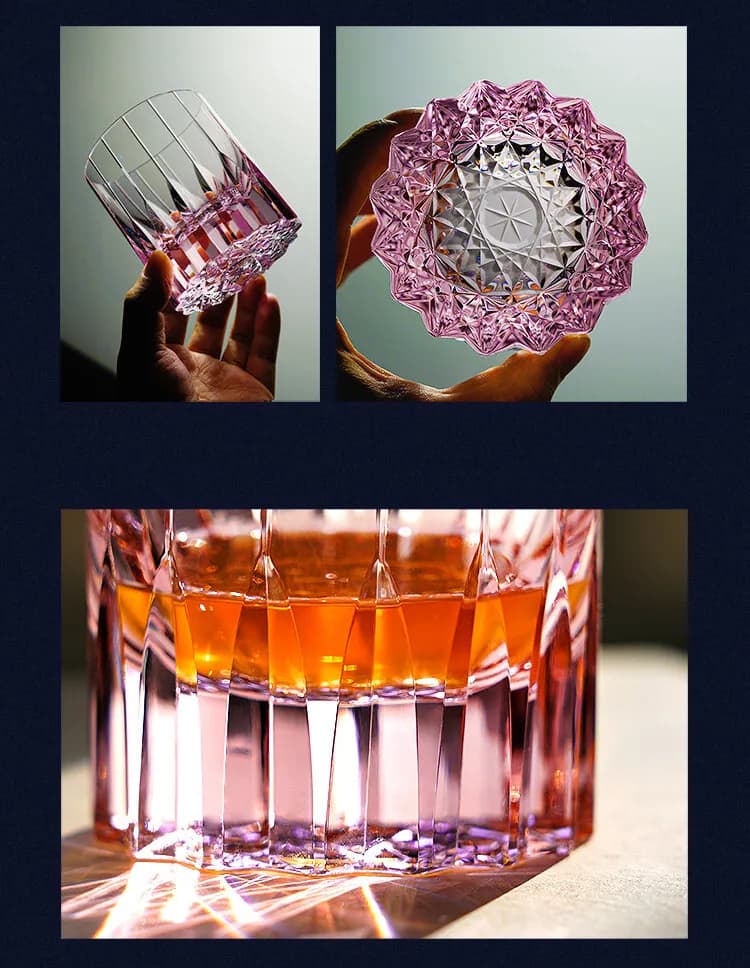
Two types of glassware. This is where minimalism meets luxury most directly. Rather than owning twelve different glass shapes, invest in two excellent types. A set of crystal rocks glasses handles whiskey, cocktails, and casual sipping. A set of stemmed wine glasses covers wine, champagne (yes, a good wine glass works for champagne), and even certain cocktails served up. Our crystal glassware is designed for exactly this kind of versatile, refined simplicity.
Three tools. A jigger for measuring, a mixing spoon for stirring, and a bottle opener. If you make shaken cocktails, add a shaker. That is genuinely all you need. The wall-mounted racks of 20 specialized bar tools are the antithesis of minimalism.
One surface. Whether it is a small floating shelf, a narrow console table, a single cabinet shelf, or a compact bar cart, contain your bar to one defined area. The physical constraint forces curation and prevents creep.
Choosing the Right Display Surface
The surface you choose for your minimalist bar is part of the aesthetic statement. It should be proportional to what it holds and appropriate to the room.
A floating shelf is perhaps the purest minimalist choice. Mounted on a wall in the living room or dining area, a single wooden or marble shelf holding a few bottles and glasses makes a strong visual statement with almost no physical footprint. It works especially well in small apartments where floor space is valuable.
A slim console table offers slightly more surface area while remaining unobtrusive. Choose one with clean lines and no unnecessary ornamentation. A console against a dining room wall, with bottles and glasses arranged with intention, functions as both bar and art installation.
A dedicated cabinet or niche. Built-in niches, small bar cabinets, or even a single shelf within a larger bookcase can house a minimalist bar beautifully. The advantage here is that you can close doors on it when not in use, maintaining clean sightlines in the room.
A compact bar cart. Even a bar cart can be minimalist if you resist the urge to fill every inch of it. A two-tier cart with three bottles on top, glassware on the bottom, and plenty of negative space reads as edited and refined rather than sparse.
The Power of Negative Space
Negative space -- the empty areas between and around objects -- is the defining feature of minimalist design. On a maximalist bar, every surface is covered. On a minimalist bar, the space between a bottle of whiskey and a pair of crystal glasses is as important as the objects themselves.
Negative space does several things. It draws attention to the objects that are present, making each one feel more significant. It creates a sense of calm and order. And it communicates that the objects on display were placed deliberately, not accumulated randomly.
In practice, this means spacing your bottles several inches apart rather than clustering them. It means placing four glasses on a shelf that could hold ten. It means leaving at least a third of your chosen surface empty. This feels counterintuitive at first -- you may feel the urge to add something to fill the gap. Resist it. The gap is the point.
Quality Over Quantity in Every Element
In a minimalist bar, every object is visible and under scrutiny. There is nowhere for mediocrity to hide. This is why quality matters so much in this context.
Spirits. When you only have three bottles, each one represents a significant percentage of your collection. Choose bottles you are proud to display -- brands with thoughtful packaging, spirits with genuine quality. A single bottle of well-aged scotch in a beautiful decanter has more impact than a dozen unremarkable bottles.
Glassware. This is arguably the most important investment in a minimalist bar. Cheap glasses undermine the entire aesthetic. Fine crystal, on the other hand, catches light, feels substantial in the hand, and signals that you take your drinks -- and your guests' experience -- seriously. Two or four truly excellent glasses are all you need. Visit our shop to find crystal pieces that embody this philosophy of fewer, better things.
Accessories. A brass jigger, a hand-forged mixing spoon, a leather coaster -- when you only have a few accessories, each one can be a small object of beauty. Choose tools that are well-made and pleasant to handle, not just functional.
Maintaining the Minimalist Bar
The ongoing challenge of minimalism is maintenance -- not physical maintenance, but the discipline of keeping things pared back. Home bars have a natural tendency to grow. Someone gives you a bottle of liqueur as a gift. You buy a specialty ingredient for a recipe. A new glass shape catches your eye.
The rule is simple: one in, one out. If a new bottle arrives, an existing one must be finished or given away. If you add a new glass to the collection, retire an older one. This discipline is what separates a truly minimalist bar from a cluttered one that has not yet had time to accumulate.
Periodically -- every few months -- step back and assess. Is everything on display something you actually use and enjoy? Is there anything that has sat untouched since the last time you looked? Remove anything that does not earn its place.
The Minimalist Bar in Practice
A minimalist home bar is not about deprivation or austerity. It is about having exactly what you need, at the highest quality you can manage, displayed with intention and surrounded by calm. When a guest walks up to your bar and sees three excellent spirits, a pair of gleaming crystal glasses, and a beautifully made jigger on a clean surface, the message is unmistakable: this person knows what they like, and they like it done well.
That confidence, that clarity of purpose, is the real luxury. Not the number of bottles. Not the array of gadgets. Just the right things, chosen with care, ready to create a perfect drink.
Shop Luxrify Crystal Glassware
Discover our full collection of handcrafted crystal glasses:
- Wine Glasses -- Iridescent & amber crystal stemware
- Whiskey Glasses -- Designer crystal tumblers & decanters
- Champagne Flutes -- Crystal flutes for every celebration
- Shop All
Free shipping on all orders. Sets of 2, 4, 6, 8 & 12 available.


